



Published 23 November 2026
Key takeaways
- Heavy refurbishment bridging is short-term, property-secured funding for projects involving major structural work, a change of use, or planning permission — not a kitchen-and-paint refresh.
- Lenders assess three things at once: the property as it stands, the works programme (and your track record delivering it), and the end/post-works value the lending is sized against.
- Money is commonly released in stages (drawdowns) against work completed, often signed off by a monitoring surveyor — which, with rolled-up interest, keeps your interest cost down because you pay only on funds actually drawn.
- “Heavy” is defined by the lender, not by you: the same scheme can be light refurb to one lender and heavy to another. Get near ground-up construction and it tips into development finance — a different product and a different lender set.
- Where the security is a home you (or a close family member) live in or intend to live in, the case is usually regulated bridging. Niche Advice Limited is a mortgage and credit broker (FRN 750263).
Important information about this guide
This article is for information, not advice. Heavy refurbishment is one of the more involved corners of bridging, and the way a deal is structured can make or break the numbers. Your project is unique, so treat what follows as a map of the terrain rather than a recommendation — then speak to a qualified adviser about your specific scheme before you commit to anything.
What is heavy refurbishment bridging finance?
Heavy refurbishment bridging is a short-term loan secured against a property you are buying or already own, designed to fund substantial renovation work. The “heavy” part is the key word. We are not talking about a new kitchen and a coat of paint — we mean projects that involve structural alteration, extensions, a change of use, or work that needs planning permission or building regulations sign-off.
Because the property is often unmortgageable in its starting condition — no working kitchen or bathroom, mid-conversion, or structurally unsound — a standard mortgage will not touch it. Bridging steps in to fund both the purchase and the works, with the plan to repay the loan at the end through your “exit”: either selling the finished property or refinancing onto a longer-term mortgage once it is habitable and lettable.
Light refurbishment vs heavy refurbishment — where’s the line?
This is the distinction that trips people up, and it matters because it changes which lenders will look at your case, how they release funds, and how they price the deal.
There is no single legal definition, so different lenders draw the line in slightly different places. As a working rule, the trigger for “heavy” is usually whether the work needs planning permission, involves structural change, or constitutes a change of use. If any of those apply, you are almost certainly in heavy-refurb territory.
| Factor | Light refurbishment | Heavy refurbishment |
|---|---|---|
| Typical works | Cosmetic: redecoration, new kitchen/bathroom, flooring, rewiring | Structural: extensions, removing walls, loft conversions, underpinning |
| Planning permission | Not usually required | Often required |
| Building regulations | Minor or none | Usually required |
| Change of use | No | Sometimes (e.g. office to residential, single dwelling to flats) |
| How funds are released | Often as a single advance | Commonly in stages, against work completed |
| Who assesses it | Standard bridging underwriters | Underwriters plus often a monitoring surveyor |
| Where it can shade into | Stays as bridging | Can tip into development finance |
The grey zone in the middle is real. A project that adds significant floor area, or one that strips a building back to a shell, will be treated as heavy by most lenders even if you would not personally describe it as “development.” When we package a case, one of the first jobs is establishing which side of this line a lender will place it.
Payam’s experience — The first thing to understand is that “heavy” refurbishment is defined by the lender, not by you. Generally, the more work you are doing — planning permission, structural change, borrowing well above the purchase price — the more likely it is treated as heavy, and the grey zone in the middle is real. That is why, before I approach anyone, I get a proper schedule of works and good information on the property: it lets both me and the lender place the case accurately. Which side of the line you land on changes the loan-to-value you are offered and the pricing — and if it tips into development territory there are extra rules, and the money is usually released in stages against the works rather than all upfront. Documenting it properly at the start is what keeps the case clean.
Who does heavy refurbishment bridging suit?
Heavy refurbishment finance tends to suit a particular kind of borrower with a particular kind of plan:
- Investors buying below market value who intend to add value through works, then refinance or sell.
- Property flippers taking on tired or distressed stock, renovating, and selling on. The numbers on a flip live or die on the cost of finance and the exit timing.
- Landlords converting a house into flats, or an unmortgageable property into a lettable one, with a buy-to-let remortgage as the exit.
- Owner-occupiers carrying out major structural work to a home that is uninhabitable during the build (this is more likely to be regulated bridging — more on that below).
- Small developers doing conversions and change-of-use schemes that are too involved for light refurb but not large enough to need full ground-up development finance.
What unites them is that the property’s value is going to change materially because of the work, and the finance has to be built around that journey rather than the property’s day-one condition.
How do lenders assess a heavy refurbishment case?
Here is where heavy refurb differs most from a vanilla bridging loan. A standard bridge is assessed largely on the current property and your exit. A heavy-refurb case is assessed on three things at once:
- The property as it stands today — the starting security and current value.
- The works programme — what you are doing, what it will cost, your schedule, and crucially your experience delivering work of this type. Lenders are far more comfortable with a borrower who has done it before.
- The end value — often called the gross development value or post-works value. A surveyor will assess what the property should be worth once the work is finished, and the lending is sized against that figure as much as the purchase price.
Lenders will want to see a realistic schedule of works and a costed budget. On larger or more structural schemes they will often appoint a monitoring surveyor who inspects progress before each stage of funds is released. They will also scrutinise your exit strategy harder than on a simple bridge, because the exit on a refurb is contingent on the work actually completing — a half-finished project is a much weaker security.
The thing generic guides will not tell you: lender appetite for heavy refurb is unusually sensitive to the borrower’s track record and the credibility of the build budget. Two people can present the identical property and identical end value, and the experienced developer with a properly costed schedule will be offered terms the first-timer with a back-of-an-envelope budget simply will not. The deal is judged on deliverability, not just the bricks.
What are staged drawdowns, and why do they matter?
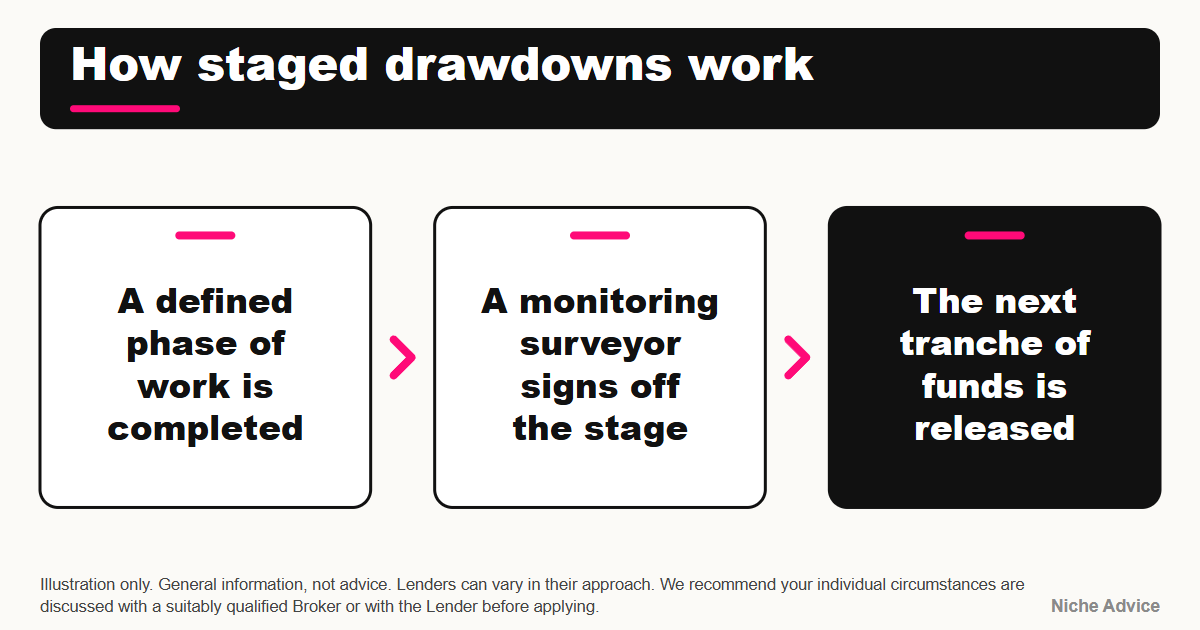
On heavier projects, lenders rarely hand over all the build money on day one. Instead they release it in stages (drawdowns), usually tied to the completion of defined phases of work — for example, once the structure is up, once it is weathertight, once first fix is done, and so on. A monitoring surveyor typically signs off each stage before the next tranche is released.
There are two ways the funds are commonly structured, and the difference affects your interest cost:
| Drawdown approach | How it works | What to watch |
|---|---|---|
| Funds released in arrears | You pay for completed work, then the lender reimburses on inspection | You need working capital to fund each stage upfront |
| Funds released in advance | The lender releases the stage before the work | Less common for heavy works; criteria are tighter |
Why does this matter to your wallet? Because with rolled-up interest (the most common structure on refurb, where interest accrues and is settled at the end), you generally only pay interest on money that has actually been drawn. Staged drawdowns therefore keep your interest cost down compared with taking the whole facility at once — you are not paying for capital sitting in your account doing nothing. Structured well, this is a feature, not a hassle. Structured badly, the cash-flow gap between paying for work and being reimbursed can catch an underfunded borrower out. It is worth working through how staged drawdowns affect your figures with an adviser before you commit, so those cash-flow gaps are planned for rather than discovered mid-build.
When does heavy refurbishment become development finance?
This is the boundary that confuses even seasoned investors, and getting it wrong can mean approaching the wrong lenders entirely.
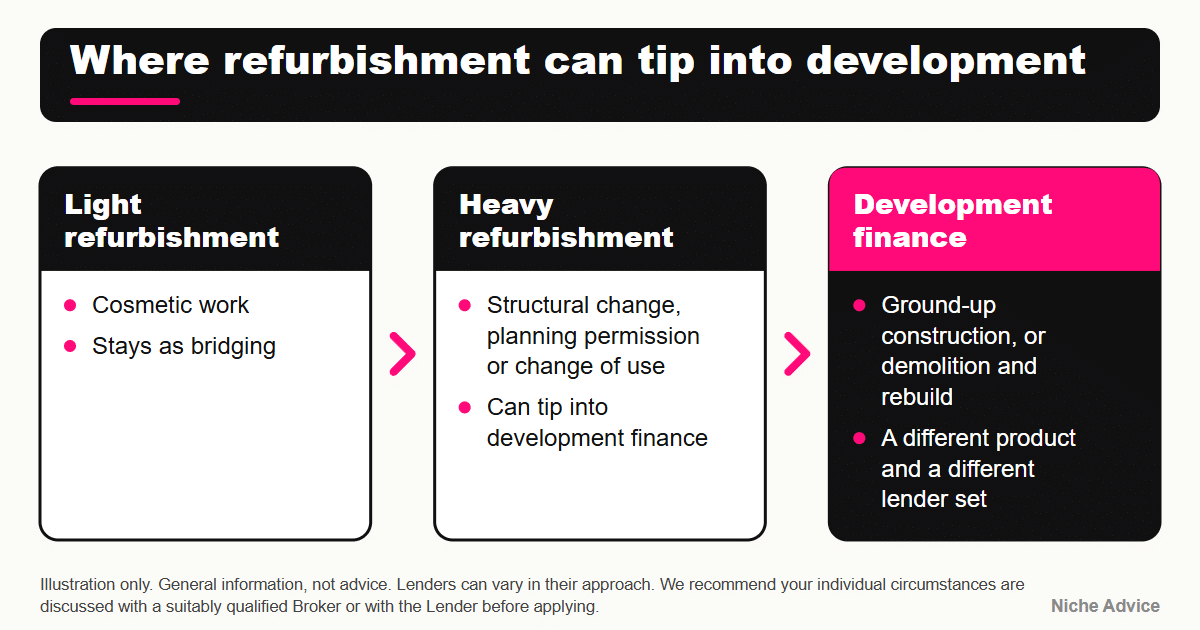
Broadly: if you are improving, converting, or extending an existing building, you are usually in refurbishment bridging. Once a scheme involves ground-up construction, demolition and rebuild, or substantial new-build floor area, it crosses into development finance — a different product with different lenders, a different cost base, and typically heavier monitoring.
The middle ground is messy. A heavy conversion that keeps the existing structure might be refurb to one lender and development to another. The practical consequence is that the right finance type depends not only on the bricks and mortar but on how a given lender classifies the work. Approaching a refurb lender with what they consider a development scheme — or vice versa — is one of the most common reasons applications stall. A specialist lender may operate across parts of this spectrum, but most lenders sit clearly on one side or the other. This is exactly the kind of judgement call where a specialist bridging broker earns their keep: matching the scheme to a lender who classifies it the way you need them to.
Why heavy refurbishment bridging finance gets declined — and how we avoid it
Most declines on heavy-refurb cases are avoidable. They tend to come from the same handful of issues:
- A vague or unrealistic exit. “I’ll just refinance” is not an exit if the post-works property will not meet a mortgage lender’s criteria. We pressure-test the exit before applying.
- An under-costed budget. Budgets that ignore contingency, professional fees, or finance costs themselves fall apart under underwriting scrutiny.
- The wrong product classification. Presenting a development scheme to a refurb lender (or vice versa).
- Thin borrower experience on an ambitious scheme. Some lenders will still lend, but the case has to be packaged to address the gap head-on rather than hope it goes unnoticed.
- No allowance for the works timeline against the loan term. If the build realistically cannot finish and exit inside the term, the deal needs rethinking before, not after, you sign.
- Planning not yet in place where the lender expects it. Some will lend pre-planning; many will not.
Before you approach anyone, it is worth having: a costed schedule of works with a sensible contingency, a clear and evidenced exit, proof of any planning consents, and an honest account of your relevant experience. That preparation is, more often than not, the difference between an offer and a polite no.
How Niche Advice can help
We arrange heavy refurbishment bridging across a panel of mainstream and specialist lenders. If you send us the basics of your scheme — the property, the works you are planning, your rough budget, and how you intend to exit — we will come back to you with an honest read on whether it stacks up, which lender types are likely to fit, and what a sensible structure looks like. No pressure, no obligation. To sketch the numbers for yourself first, use the bridging loan calculator to model a scenario, or call 020 7993 2044 / get in touch with our team to talk it through.
Heavy refurbishment bridging — frequently asked questions
Is heavy refurbishment bridging regulated by the FCA?
It depends on the property. If the loan is secured against a property that has been, is, or is intended to be occupied as a dwelling by you (or a close family member), it is usually regulated bridging and carries the associated consumer protections. Refurbishment of an investment or commercial property is typically non-regulated. The distinction changes which lenders apply and the process, so it is the first thing to establish.
Can I borrow for both the purchase and the building works?
In many cases, yes. Heavy refurbishment facilities are commonly structured to fund a portion of the purchase price plus an allowance for the works, with the works element often released in stages as the project progresses. How much is available against each depends on the property, the end value, and your experience — it is very case-specific.
Do I need planning permission before I apply?
Not always, but it strongly affects your options. Some lenders will consider a case before planning is granted; many prefer consent to be in place, especially where the works depend on it. Where planning is outstanding, that should be flagged at the outset so we approach lenders whose criteria allow for it.
What happens if the refurbishment takes longer than expected?
Overruns are common, which is why the loan term and a realistic works timeline have to be aligned from the start. If a project looks likely to run beyond term, the options can include a term extension or refinancing, but these are not automatic and may carry cost. Building in a sensible buffer at the application stage is far better than negotiating under pressure later.
How is interest usually paid on a refurbishment bridge?
Most refurbishment bridges use rolled-up interest, where the interest accrues over the term and is settled at the end alongside the loan, rather than as monthly payments. This suits projects where the property is generating no income during the works. Serviced and retained options also exist; which is right depends on your cash flow and the deal.
Is heavy refurbishment finance more expensive than a standard bridge?
It can be, reflecting the added complexity, the staged monitoring, and the contingent exit. That said, cost is driven by the loan-to-value, the property, the strength of the exit, and your circumstances rather than any single headline figure — which is why we model each scenario individually rather than quoting a one-size-fits-all rate.
Heavy refurbishment bridging: summary and next steps
Heavy refurbishment bridging rewards preparation and honesty: a costed schedule with contingency, an exit you have evidenced, the right lender for how your scheme is classified, and a term that fits the build. Get those right at the start and the staged, monitored structure works in your favour rather than against you. This is general information about how heavy refurbishment bridging works, not advice on your situation; a personalised recommendation requires a fact-find and, where applicable, a regulated conversation. Talk it through with us: 020 7993 2044, or model a scenario on the bridging loan calculator first.

Speak to a specialist mortgage adviser today.
UK specialist mortgage broker. Your enquiry will not affect your credit file.
Related guides & tools
- What are bridging loans? — the overview this guide builds on.
- Development finance — when a scheme goes beyond refurbishment.
- FCA-regulated bridging: when it applies — how regulation affects bridging.
- How much does bridging finance cost? — what drives the cost.
- Bridging loan calculator — model indicative figures for your own scenario.
- Contact us / request a callback — talk your case through with a specialist adviser.
Sources
- legislation.gov.uk — The Financial Services and Markets Act 2000 (Regulated Activities) Order 2001, article 61. https://www.legislation.gov.uk/uksi/2001/544/article/61
- FCA Handbook — PERG 4.4: Regulated mortgage contracts and bridging loans. https://www.handbook.fca.org.uk/handbook/PERG/4/4.html
- Planning Portal — do you need planning permission / building regulations. https://www.planningportal.co.uk/
- GOV.UK — Building regulations approval. https://www.gov.uk/building-regulations-approval
- RICS — valuation and monitoring surveyor guidance. https://www.rics.org/
- FCA — Financial Services Register entry for Niche Advice Limited (FRN 750263). https://register.fca.org.uk/