

Published 8 December 2014 · Older article — see current rates
Stamp Duty Calculator
Work out the Stamp Duty Land Tax (SDLT) on a property purchase in England and Northern Ireland — for main homes, second homes, buy-to-let, limited companies and commercial / mixed-use property. Figures are illustrative; confirm your liability with HMRC or a qualified tax adviser. Scotland uses LBTT and Wales uses LTT, which have different scales.
Band-by-band breakdown
| Band | Rate | Taxable | Duty |
|---|---|---|---|
| Total SDLT | £7,500 | ||
2026 SDLT rate tables (England & Northern Ireland)
Rates last checked against GOV.UK: 29 June 2026.
Standard residential
| Portion of price | Rate |
|---|---|
| Up to £125,000 | 0% |
| £125,001 to £250,000 | 2% |
| £250,001 to £925,000 | 5% |
| £925,001 to £1,500,000 | 10% |
| Above £1,500,000 | 12% |
First-time-buyer relief (purchase £500,000 or less)
| Portion of price | Rate |
|---|---|
| Up to £300,000 | 0% |
| £300,001 to £500,000 | 5% |
No first-time-buyer relief if the price is above £500,000 — standard rates apply to the whole price.
Additional property / second home / buy-to-let / limited company (price £40,000+)
| Portion of price | Rate |
|---|---|
| Up to £125,000 | 5% |
| £125,001 to £250,000 | 7% |
| £250,001 to £925,000 | 10% |
| £925,001 to £1,500,000 | 15% |
| Above £1,500,000 | 17% |
Purchases under £40,000 are charged at standard residential rates (no higher-rate surcharge).
Non-residential / mixed-use freehold
| Portion of price | Rate |
|---|---|
| Up to £150,000 | 0% |
| £150,001 to £250,000 | 2% |
| Above £250,000 | 5% |
No 5% additional-dwelling surcharge applies to non-residential / mixed-use.
Worked examples
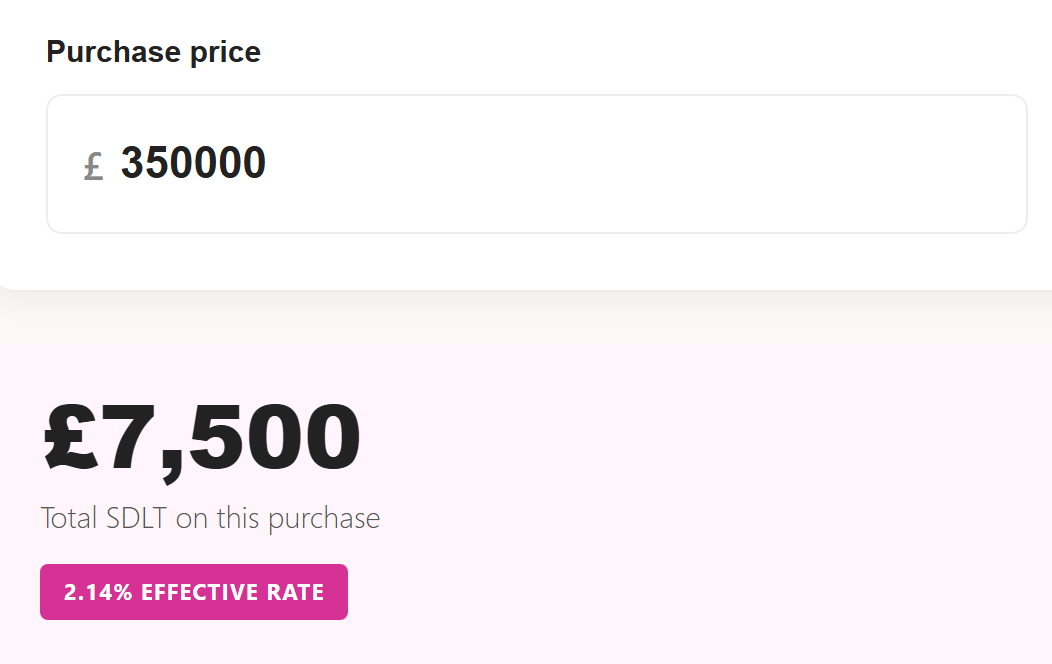
- Standard residential, £350,000: 0% on £125,000 + 2% on £125,000 (£2,500) + 5% on £100,000 (£5,000) = £7,500.
- First-time buyer, £500,000: 0% on £300,000 + 5% on £200,000 = £10,000.
- Second home / buy-to-let, £350,000: 5% on £125,000 (£6,250) + 7% on £125,000 (£8,750) + 10% on £100,000 (£10,000) = £25,000.
- Limited company, £350,000: additional-dwelling rates = £25,000. A single-dwelling company purchase above £500,000 may instead attract the 17% flat rate where no relief applies — this calculator does not model that; speak to a tax adviser.
- Commercial / mixed-use, £600,000: 0% on £150,000 + 2% on £100,000 (£2,000) + 5% on £350,000 (£17,500) = £19,500.
How the result is worked out
SDLT is charged in slices, not as one flat rate on the whole price. Each band applies only to the part of the price that falls inside it, so your effective rate is always lower than the top band you reach. The breakdown table above shows the duty on each slice. Selecting a second home, buy-to-let or limited-company purchase applies the higher rates; selecting commercial / mixed-use applies the non-residential bands with no surcharge.
Important points before you rely on a figure
Replacing your main residence (timing): if you are replacing your main residence but have not yet sold the previous one, you normally pay the 5% surcharge up front and can reclaim it — but only if you sell the previous main home within 3 years, and you must claim within 12 months of the later of that sale or the filing date of the new SDLT return.
Limited companies: companies buying residential property generally pay the additional-dwelling (higher) rates, which apply to purchases of £40,000 or more. A single-dwelling company purchase above £500,000 may instead attract the 17% flat rate unless a relief applies (for example, the property is used in a property-rental business or a property-development trade). This calculator does not apply the 17% flat rate — speak to a qualified tax adviser if it may apply.
Mixed-use classification: whether a property is residential, non-residential or mixed-use is a legal classification that depends on the specific property — a tax adviser or conveyancer should confirm the correct classification before you rely on a figure. HMRC challenges weak “mixed-use” claims.
Non-UK residents: a non-resident surcharge of +2 percentage points can apply on top of the standard and additional-property rates, and it stacks. Tell us if this applies and we will factor it into your finance.
Leasehold: this calculator works out SDLT on the purchase price (the freehold or premium). It does not calculate the net present value (NPV) of rent on a new lease. If you are buying a new leasehold with a significant ground rent, the SDLT on the rent element is separate — ask your conveyancer.
Rates apply to England & Northern Ireland (SDLT). Scotland uses LBTT and Wales uses LTT — different scales.
Frequently asked questions
Do you pay stamp duty when buying through a limited company?
Yes. A company buying residential property pays the additional-property surcharge on the full purchase price, and first-time-buyer relief does not apply. Use the calculator for your indicative figure.
Is stamp duty higher on a buy-to-let?
If it’s an additional residential property, the surcharge applies — whether you buy personally or through a company.
What about mixed-use or semi-commercial property?
Mixed-use purchases can be assessed on the non-residential SDLT scale, which is often lower than residential-plus-surcharge. The calculator handles this case.
Do non-UK residents pay extra stamp duty?
A non-resident surcharge can apply on top of the standard and additional-property rates. The calculator does not add this automatically — tell us if this applies and we will factor it into your finance.
Are the figures exact?
They’re indicative. SDLT depends on your circumstances and current HMRC rules, which change at fiscal events — confirm the final figure with your conveyancer.
Get advice from a whole-of-market specialist
Stamp duty is only half the picture — the finance is the other half. For figures tailored to you, request a callback from an FCA-regulated adviser. We arrange bridging and specialist mortgages every week.