



Published 24 November 2026
This article is about county court judgments (CCJs) in England and Wales. The rules in Scotland and Northern Ireland differ.
The short answer from this case: the judgment was removed from the public Register 49 days after the hearing (6 days after the sealed order was issued), and a combined credit-file view first showed no court information 52 days after the hearing. Your own timing will differ, because each stage depends on the court, Registry Trust and each credit-reference agency.
- 43 dayshearing to sealed order issued
- 6 dayssealed order to removal from the public Register
- 3 daysRegister removal to a clear combined credit-file view
- 52 dayshearing to first clear combined view
Intervals from the dates in this one case. They are not typical processing times.
A set-aside order does not necessarily clear your credit file overnight
We regularly speak to people whose mortgage plans are affected by a County Court Judgment. One question that comes up is what happens after a court sets a CCJ aside. Does it disappear straight away? Does the court update your credit report? And what can you do if it is still showing weeks later?
This article follows an anonymised real-world case from the court hearing through to the credit report update. What stands out is the gap between the court making its decision, issuing its sealed order, updating the public register and the credit-reference agencies reflecting the change. The person had to chase the process rather than assume every stage had completed.
Who can apply to set a CCJ aside?
A set-aside is for a judgment that should not stand, for example because the person does not owe the money or did not receive or respond to the claim. Whether a judgment is set aside depends on the type of judgment, the grounds and how promptly the application is made (see CPR Part 13), and the court decides. It is not a way to remove a debt that is owed, and paying a CCJ later is a different route. The application is made to the court, a hearing is usually held, though some applications can be decided without one, and you may have to pay a court fee (currently stated on gov.uk as £321; the fee can differ for some applications, and help with court fees may be available, so check the current position before applying). A set-aside does not necessarily end the underlying claim, which may still continue.
The four stages after a set-aside
- 1
Court hearing and decision
A judge decides whether the judgment should be set aside.
- 2
Sealed order and court notification
The written sealed order may follow later. If it is delayed, ask the court for its status in writing and keep proof of contact.
- 3
Registry Trust
The court should instruct Registry Trust to remove a set-aside judgment from the public Register. Independent court confirmation may still be needed.
- 4
Credit-reference agencies and monitoring services
Check Experian, Equifax and TransUnion individually after the Register changes. They can update at different times. A combined “no court information” message is useful evidence but does not show when each agency processed the update.
How long did this case take? The documented timeline
- 25 August 2026Hearing
Hearing at which the court set aside the judgment.
- 8 September 2026+14 days
Follow-up email sent to the court asking for the sealed order.
- 2 October 2026+24 days
Two calls to a court number, each around 20 minutes, without reaching a member of staff able to help.
- 7 October 2026Day 43
Sealed order issued, roughly six weeks after the hearing.
- 8 October 2026, 13:45
Email to Registry Trust attaching the sealed order, asking whether the set-aside had been received from the court.
- 8 October 2026, 16:563 hours 11 minutes later
Registry Trust replied that it had not received the court instruction and had emailed the court at 16:55 to verify the set-aside.
- 13 October 2026, 16:01Day 49
Registry Trust confirmed the court had responded, the judgment had been removed from the public Register and the relevant credit-reference agencies had been advised.
- 16 October 2026Day 52
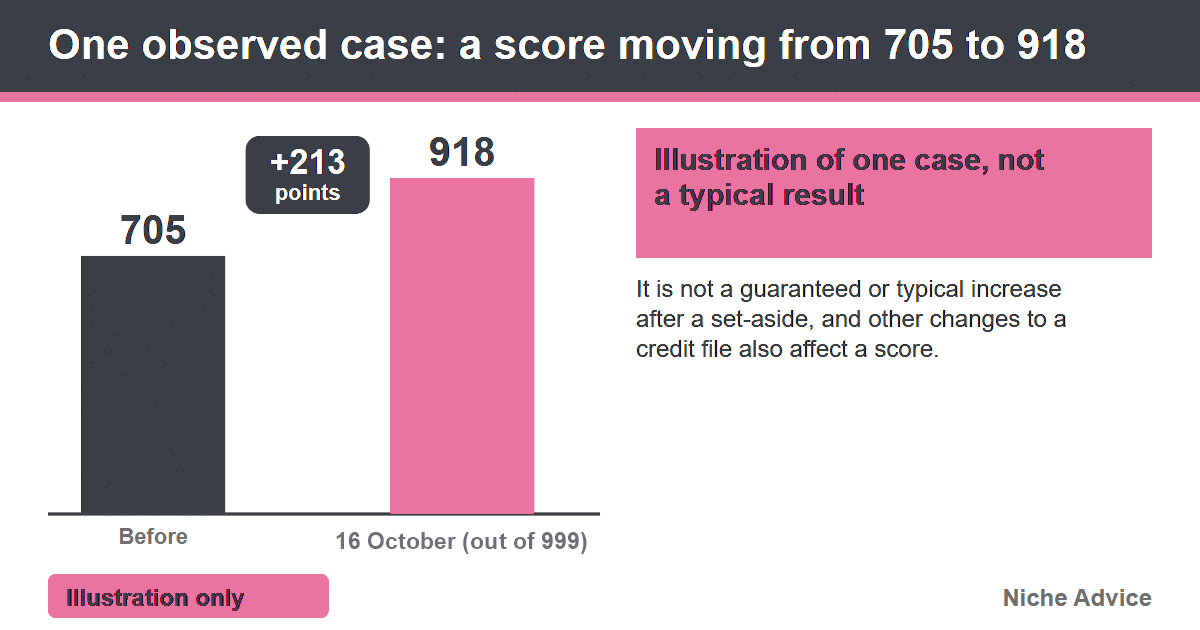
Checkmyfile showed no court information reported, with a score of 918 (out of 999), up 213 points from 705.
Important: 16 October is the first documented date the combined Checkmyfile court-information view was observed clear. It is not proof that each agency processed the removal that day. The score rise was observed at the same time as this update. It is not evidence that removal was the only factor in the score.
Why it can be hard to get hold of the court
The person was told the court would notify Registry Trust automatically. Waiting for that update was not straightforward. Calls to the court involved long queues, calls ending after around 20 minutes, and a central contact service that could give general information but could not confirm whether the specific sealed order had been received or processed.
In practice, it helps to do more than telephone the court. Find the court handling the case using the official GOV.UK court and tribunal finder, work out whether the public number is a national contact centre or a local line, and create a written trail. Record the date and length of calls, keep the emails you send, and ask a focused question: “Has the sealed order been issued, and has the set-aside notification been sent to Registry Trust?”
In this case the person also sent Registry Trust a copy of the sealed order once it arrived. Registry Trust replied 3 hours 11 minutes after that email. It said it had not yet been notified by the court and had raised a query with the court at 16:55 on 8 October. Registry Trust verified the information with the court rather than relying on the attachment. This matters: sending an order to Registry Trust is not a guarantee of immediate deletion. Registry Trust’s website says it changes the Register on an instruction from the county court, and that the court should notify it when a judgment is set aside.
What the Registry Trust emails show about the process
This section is based on time-stamped emails from the case, not on memory. Names, claim numbers and identifying details are excluded.
- 8 October, 13:45, request: the sealed order was sent and Registry Trust was asked whether the set-aside had been received and when the Register would be corrected.
- 8 October, 16:56, Registry Trust reply: it had not yet received the court’s notification and had contacted the court at 16:55. The person was also advised to contact the court and ask it to update its CaseMan system or respond to Registry Trust’s query.
- 13 October, 16:01, resolution: following the court’s reply and a court amendment notification, the judgment was removed from the public Register. Registry Trust said it had also advised the credit-reference agencies that held the entry, and told the person they normally take about a week to update their files. That is what Registry Trust said in this case. We did not find a stated timeframe for that stage on the Registry Trust page we checked, so please do not treat a week as a guaranteed or standard period.
These emails do not show any chasing of the court between 8 and 13 October. The public Register was corrected five calendar days after the email to Registry Trust. That is a case-specific outcome, not a service standard.
Example email: asking Registry Trust to confirm a set-aside
Dear Registry Trust,
The court has issued a sealed order dated [date] confirming that the judgment in claim [claim number] was set aside. I attach a copy for reference.
I understand the court should notify Registry Trust directly. Please confirm whether you have received that notification and whether the entry has been removed or is awaiting a court instruction.
If verification is outstanding, please could you confirm whether you have contacted the court and whether there is anything further I should ask the court to do?
Kind regards,
[Your name]
Give identity and case details privately to the organisation concerned, as it asks. Do not post them in online comments or shared screenshots.
What happened to the credit score?
On 16 October, Checkmyfile showed a score of 918 (out of 999), a 213-point increase from 705. This increase was specific to this case.This is one observed case. It is not a guaranteed or typical increase after a set-aside, and other changes to a credit file also affect a score.
A credit score alone does not decide mortgage eligibility. Lenders make their own assessment, including affordability, deposit, conduct and the information given in the application. A successful set-aside does not guarantee a mortgage or any particular rate.
What to do if your set-aside CCJ is still showing
- Check what the sealed court order says and keep a legible copy.
- Find the right court with the GOV.UK court and tribunal finder and check where the case is currently managed.
- Email the court with your case reference and ask it to confirm that Registry Trust has been notified. Log any calls that fail.
- Contact Registry Trust and ask whether it has received the court’s instruction. Do not assume an attachment replaces verification. See its page on cancelling or setting aside a CCJ.
- Once removal from the public Register is confirmed, check Experian, Equifax and TransUnion separately and keep dated screenshots.
- If an agency still shows an inaccurate entry, send a correction or dispute with your documents and ask what confirmation it needs.
- Keep a simple diary of dates, scores and each agency’s status. The first date you see it clear may not be when the agency updated.
For the application itself, see GOV.UK: cancel a county court judgment.
Common questions about CCJ set-asides and credit files
How long does it take for a set-aside CCJ to disappear from a credit report?
In this case, 9 days after the sealed order was issued and 52 days after the hearing, the combined Checkmyfile view first showed no court information; the public Register had been corrected 3 days earlier. Other cases may be quicker or slower, and each agency can update at a different time. Check each stage rather than assuming a fixed period.
Will a set-aside CCJ automatically disappear from my credit file?
The court should notify Registry Trust, whose data credit-reference agencies use. There can be a lag between the court’s decision and what a credit report shows. Check each stage instead of assuming everything updates at once.
What if Registry Trust says it needs to verify the order?
Ask whether it has asked the issuing court to confirm and whether it needs any more detail to identify the case. Also ask the court in writing whether the set-aside notification has been sent. Do not treat a copy of the sealed order as a substitute for the court’s instruction.
Why does the court number go to a contact centre?
Some courts publish national enquiry lines and sometimes separate local numbers for appointments or payments. A contact centre may not hold the case record or have authority to confirm processing. Use the official listing and follow up in writing.
Will my credit score go up by 213 points?
Not necessarily. That was the observed increase in one case. Every person’s score and lender assessment is different.
Can I get a mortgage after a CCJ is set aside?
Possibly, depending on the lender’s criteria and your wider circumstances. A set-aside that has been recorded correctly on your credit reports may help, but it does not guarantee a mortgage. Be ready to explain what happened and provide the sealed order and evidence that your reports are corrected. A mortgage broker can talk through your own circumstances.
Related guides
- Bad credit mortgages
- Will paying off my CCJ help me get a mortgage?
- Mortgage solutions for CCJs: an at-a-glance guide
- Deposit levels needed to get a mortgage with a CCJ
- CCJ remortgage options
Sources
- GOV.UK: Cancel a county court judgment
- Registry Trust: Cancelling or setting aside a CCJ and how CCJ data reaches credit reference agencies
- GOV.UK: Find a court or tribunal
- Civil Procedure Rules: Part 13, setting aside or varying default judgment
- GOV.UK: Civil court fees (EX50) and help with court fees
- ICO: Credit and your rights
- Checkmyfile: What score should I aim for?